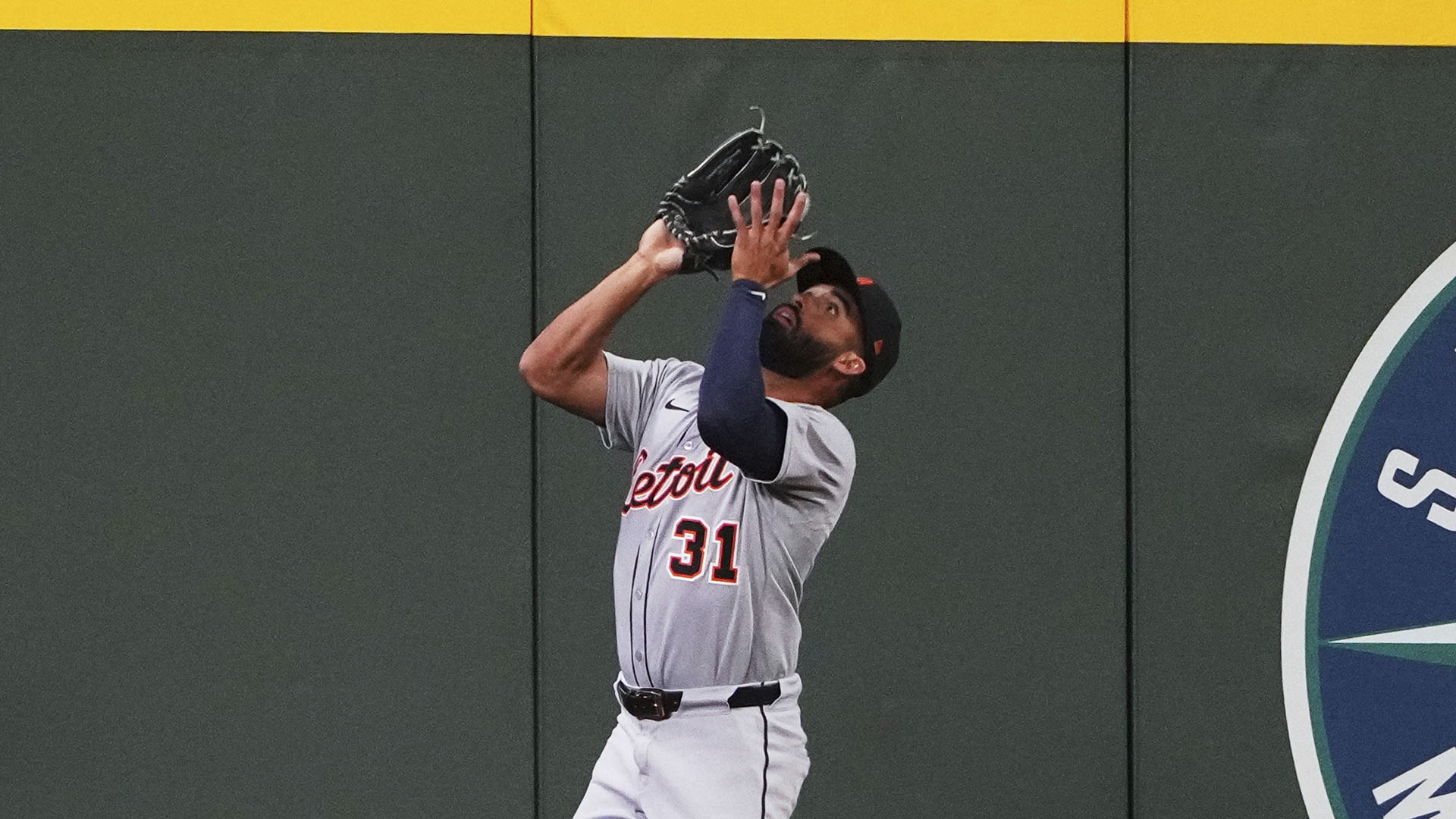
Detroit Tigers center fielder Riley Greene catches a long fly ball from Seattle Mariners' Ryan Bliss during the second inning of a baseball game Monday, March 31, 2025, in Seattle. (AP Photo/Lindsey Wasson)
Welcome to this edition of the Tigers Beat newsletter.
DETROIT – If you’re reading this after sleeping in on a Sunday, good morning (or afternoon). Think of Riley Greene, who could well be doing the same thing if the Tigers didn’t have a day game. Let the early birds have their time, but the art of sleep – shunned by some – is one of the key factors that have allowed Greene to take the leap from a talented, young but injury-prone player into one of baseball’s iron men. The injury list from Greene’s first few seasons reads like a varied series of mishaps. A fractured right foot on a foul ball in Spring Training delayed his MLB debut in 2022 until June. A stress fracture in his left fibula cost him about six weeks in 2023, then his season ended with Tommy John surgery to repair an elbow injury suffered on a diving catch. A right hamstring strain sidelined him for about three weeks in the summer of 2024. Since then, Greene has been not only durable, but available. He has played in all 83 Tigers games so far this season, joining Baltimore’s Pete Alonso, Seattle’s Cole Young and Tampa Bay’s Junior Caminero as the AL’s true everyday players. He’s also the first Tiger to appear in the team’s first 83 games in a season since another All-Star outfielder, Yoenis Cespedes, who played in Detroit’s first 102 games in 2015 before he was traded to the Mets for Michael Fulmer.
“I’ll ruin the Riley story eventually and give him a day off,” manager A.J. Hinch warned. At the same time, Hinch added, “The badge of honor with playing every day and posting every day, I think it’s super important for players to have that mentality. I do love that.” Greene has plenty of reasons for his endurance, from improved diet to a daily workout and recovery routine to maintain his body. But sleep is one of the first factors he cites. “I try to sleep as much as I can,” he said earlier this month. “I mean, on [a recent] off-day, I slept 12 hours. As much sleep as I can.” Some sports teams and athletes have hired sleep specialists to consult on the best sleep times and patterns and how to maximize the benefit. Greene’s affinity isn’t quite that technical. At the same time, it’s not simply going home and crashing on the couch. There’s a method to Greene’s sleep patterns, from off-days to night games.
“Obviously you can read and see that sleep is very good for you.” Greene said “Trying to get into the deep sleep and the REM sleep and all that stuff that I don’t really know much about. You read online that it’s good for muscle recovery. … “I love sleeping. I try to sleep as much as I possibly can.” Greene has also invested in this. He bought an Eight Sleep mattress cover last month that heats and cools his body during sleep to regulate body temperature. He gets a sleep score that he can compare night to night. Still just 25, he has adapted a lot from his early career, when he would lie in bed checking his phone instead of making a conscious effort to sleep.
“It probably started three years ago,” Greene said. “I was like, ‘I should probably get off my phone now and sleep.’ Because I could scroll on my phone until 3 in the morning, you know? If I’m in bed at 11, I should probably go to bed instead of scrolling my phone.” Or as he also put it, “When I was 22, I’d just show up. I didn’t know better.” Now he knows. But he doesn’t stay up late at night worrying about it. Ideally, he doesn’t stay up much at all. “Invest in the body, and it’ll work out,” he said. “Just trying to find ways to recover just a little bit more.”